
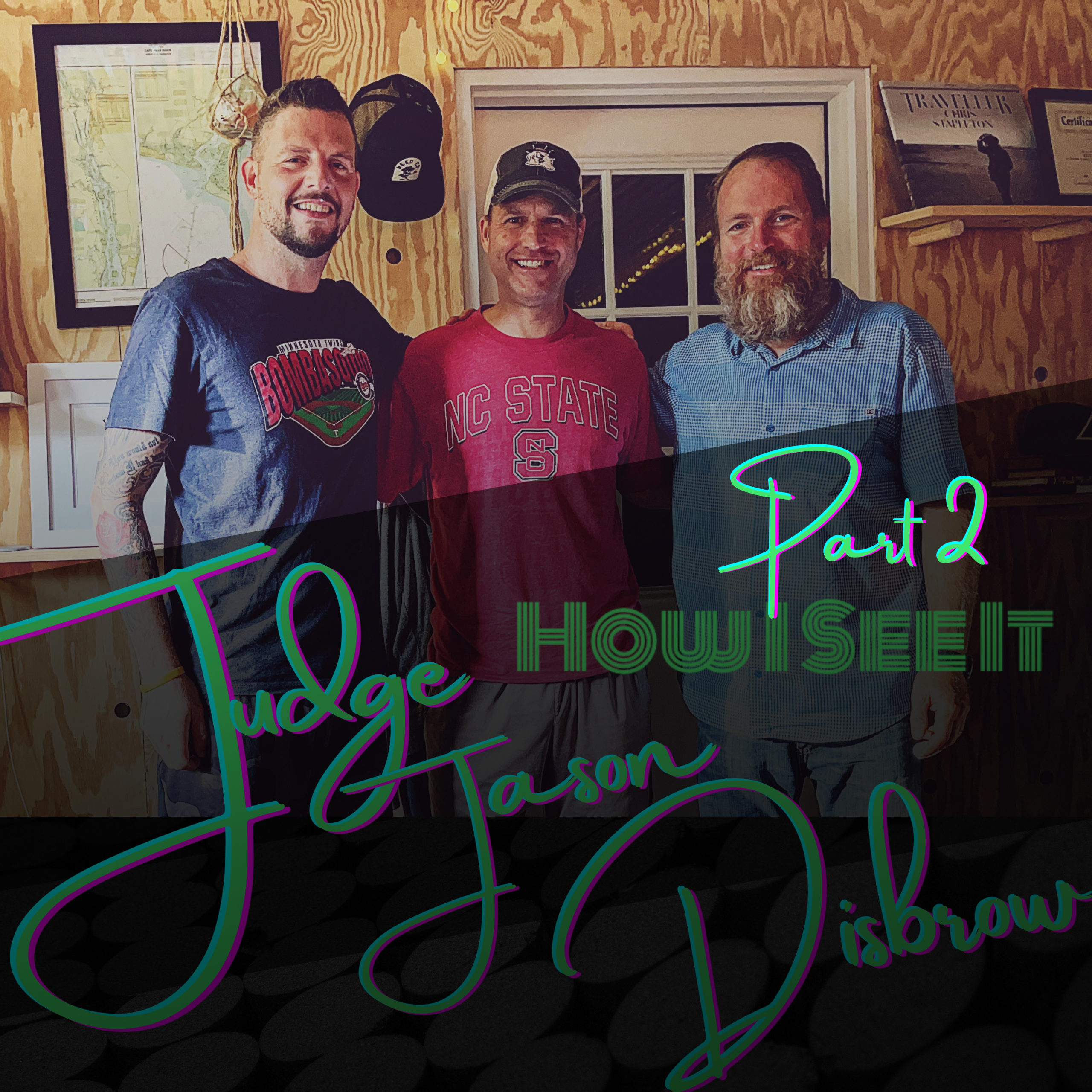
Happy Day-after-the-4th! We hope you had your fill of fireworks and funnel cake as we celebrated the anniversary of our nation’s declaration of freedom!
Last week we shared the first part of our chat with Senior Resident Superior Court Judge Jason Disbrow. We’ve heard a lot of great feedback on the episode, as Judge Disbrow shared some thought-provoking insight into the workings of the court, and we discussed the inherent polarized views of “the law.” Part 2 is no exception, as the continued conversation veers in a more personal direction.
Show Notes
Show Transcript
Mark:
Welcome to How I See It with me, Mark Pratt and
Justin:
Justin Sternberg. This is a podcast that works to counter cultural polarization. through thoughtful conversations. Hello, welcome back to the How I See It podcast. If you’re tuning in for the first time, we are so happy to have you If you’ve been around a little bit, we’d love for you to show your support for this podcast through doing things like recommending us on your show social networks. This could be as simple as just, you know, share one of the episodes you really enjoyed. Um we also it helped it’s helpful when you like our social media posts, share those. And especially when you subscribe to the podcast through whatever podcasts or music playing service that you use You might be surprised to know that when you do these things, um, this this is what they call engagement. Uh, and these algorithms really care about this stuff. So When you show that you care about what we’re producing here, it’s more likely that the various social networks will will promote what we’re doing and share it because there’s engagement there. So we love it when you support us in that way. Last week we shared with you the first part of our chat with Judge Jason Disbrow, and we’ve heard so much great feedback on that episode. We’re really happy to share with you today the continuation of this interview, where the conversation veers in a more personal direction. So we hope you enjoy.
Jason:
And it I think it’s a good thing that the motion gets twenty days for trailing to pay a fine as opposed to you’re driving with your license remote because you’d been convicted of driving while impaired. There should be different levels of punishment and those should be different misdemeanors. So the legislature made that change. Another change the legislature made. uh possession of of marijuana. Possession of marijuana paraphernalia. Possession of drug paraphernalia depending on the paraphernalia was a class one misdemeanor. It anything used to be a class one misdemeanor. Now possession of marijuana paraphernalia is a class three misdemeanor.
Mark:
Sure.
Jason:
A lower level Again, lower punishment.
Mark:
Yeah.
Jason:
Possession of marijuana is a class three misdemeanor, depending on the amount. So there’s a and of course there’s a move across the the nation to to legalize marijuana altogether and with with medical marijuana. uh being legal in many, many states and will probably be legal in North Carolina at some point.
Mark:
Wow.
Jason:
The legislature is i th they’re taking these steps uh I I think to uh almost get them to the point of civil penalties where as opposed to making it criminal you you pay a fifty dollar civil penalty and that’s not what it is currently but that’s It w we seem to be moving towards that i in North Carolina and in many other states uh across the country where it’s And not only is it not criminal, but there’s no civil penalty as well.
Justin:
Right.
Jason:
And that I’m not implying that I agree with that uh philosophy, but I certainly understand that philosophy from a legislative perspective.
Justin:
Yeah. Also fighting the tide seems like a losing battle in many ways. Fiscally, for instance, I mean the amount of Uh hey, you know just generally speaking, right, that’s one of the complaints against the drug the war on drugs, right, is like how much resources we put into that and So the idea that marijuana is legalizing to you know across the country and we’re trying to keep this I mean that seems pretty irresponsible. uh to try and hold that line. Um that that’s just my armchair how I see it. Sure.
Jason:
Yeah, no, I I and I think a lot of folks I think a lot of folks see it that same way, Justin, which I think this is somewhat of the compromise that our legislature has made uh with it thus far. And like I said, I I think you’ll see further further compromise and
Mark:
that is a tremendous change that’s basically occurred within the past three years.
Jason:
Yeah, with three years. uh uh of of decreasing
Mark:
yeah
Jason:
uh the the criminal aspect of that. And there’s
Mark:
specifically marijuana.
Jason:
Yes.
Mark:
More so thanks.
Jason:
And then I’ll give you uh you know one more area that comes to mind of what I What I think is significant change in North Carolina are uh expungements.
Mark:
Okay.
Jason:
Uh an expungement is it’s basically wiping your record clean.
Mark:
Okay.
Jason:
When I first started practicing law back in 1998, it was very limited what you could expunge.
Mark:
What what decided? I mean, as far as those limitations.
Jason:
The law. The legislature decided these type of cases you can extract from your record. Very few felonies could be expunged.
Mark:
Okay.
Jason:
Uh it was mainly misdemeanors. A lot of times there were age limitations that you had to be convicted between, you know, eighteen and and twenty-one, depending on the crime again. That has been expanded.
Mark:
Wow. uh uh
Jason:
significantly uh tenfold where now you can be uh you can expunge nonviolent felonies after ten years. Uh some of them are you know fifteen year wait. Significant felonies.
Mark:
Okay.
Jason:
And I
Mark:
But you said non-violent.
Jason:
Correct. Non-violent. Yeah. The violent felonies have a hard time getting uh armed robbery.
Mark:
Yeah, yeah. That’s what that’s who I was.
Jason:
Drug trafficking commit. Yeah, things like that are not going to be expunged. But Uh this type of ch this wave of change that that I’ve seen from the from the legal perspective that that comes from our legislature and really is again a push across the country, I think is It it shows grace on our part as as people.
Justin:
Yeah, I was gonna ask, what’s your take on that? How do you what do you f how do you see that? Like
Jason:
I think it’s a great thing. We all make mistakes. And I realize we all don’t make mistakes that necessarily violate the law. But I think it’s shameful for us as a country if a 24-year-old kid, because they’re still a kid in my eyes, um Does something stupid and is convicted of uh possession of cocaine, possession of marijuana, whatever it is, name your felony, and They have that scarlet letter for the rest of their life. I see a lot of good people in the courtroom
Mark:
Hmm, they
Jason:
who come before me. And I know that that may shock a lot of people. They’re good people who are struggling with addiction. who are are in this position because they’ve gone through a a a horrible divorce and they just they they just fell apart uh who didn’t have a dad in their house since they were six years old and haven’t had any guidance or didn’t have a mother around. Have been hanging out with the uh uh the wrong crowd for the past few years. Those people, you know, we all deserve a chance to to show that we can we can get this thing right.
Mark:
Mm-hmm.
Jason:
And all crimes are not created equal. You know, w we all come from different environments and I I think it’s important that we We remember grace and and we remember uh that w I you know I think we’re a country of second chances. And I think that uh we We have a justice system that is a justice system of second chances. I mean, most people are put on probation. To me, that’s giving you a second chance to get it right. So
Mark:
Demonstrating your willingness to want to change it. That’s right. That’s right.
Jason:
It doesn’t mean you don’t get punished.
Mark:
Sure.
Jason:
But it means the punishment is not what it could be because we’re going to give you an opportunity. Yep. to to get this thing straightened out. You know, for instance, someone comes in and um they’re in a domestic they’re in a relationship and they commit domestic violence against their wife. Yeah uh now That’s tough for me because I was I was brought up you’d never put your hands on on a female, period. Doesn’t matter what they do to you. They you know they they kick you in the privates, you take it and you move on. That’s how I was taught. So I’ve I’ve got some bias towards that And I and I recognize that that I’ve gotten an implicit bias, so I have to check myself. But you know, oftentimes we we order folks We give them a suspended sentence for you know for this assault if it’s their first first offense.
Mark:
Sure.
Jason:
We order them into what’s called a domestic violence offender program that is twenty-six weeks. It’s pretty expensive. I think it’s a thousand dollars for somebody to pay. So they go through it’s a
Mark:
of their personal money.
Jason:
Their personal money. One hour a week they go to this class and they learn about uh yeah domestic violence and and how to you know control your temper. I’ll I’ll leave that to to the expert Mark the counselor. But you know they they learn tools in order to deal with that. And we we give them community service to do, as opposed to putting them in jail for 30 days and saying, okay, you’re done with your sentence. Because at the end of the day, I’m not sure that really fixes anything.
Justin:
Right.
Jason:
If we haven’t given them any tools to maybe prevent this behavior in the future, then am I have I really done my job as a judge to help this community make this community better? Now look. If the individual is put on probation, refuses to go to the domestic violence offender program
Justin:
classes,
Jason:
doesn’t do his community service, and picks up a new charge, He’s going to prison. You know, we’re gonna activate his sentence, he’ll go to prison because he’s refused to do his probation. But that that’s on him.
Mark:
Yeah.
Justin:
Yeah, yeah.
Mark:
That’s not the grace of the thing. Given the opportunity.
Justin:
That’s correct. Yeah, yeah, yeah.
Jason:
That’s correct. You can extend grace if they don’t If they don’t appreciate and take advantage of that grace, why? Okay. That’s something that they have to deal with. That’s not. That’s not really an issue that that I have to deal with.
Justin:
That’s like what I tell my kids, like you’re choosing your consequence.
Jason:
That’s right.
Justin:
I tell you up front what’ll happen if you do the thing. If you do the thing, you choose that consequence. That’s your that’s your choice. Okay. You chose it. You know, and at that point, yeah.
Mark:
But it’s interesting that you, and I think that’s part of the the polarization to a certain degree. It’s like by implementing consequences, you’re the mean dad. You know what I’m saying? In in our culture, in our world, it’s like, well, that’s just being mean. Because I just want I just want continued grace, grace, grace, grace, grace. and overlook it, whether it’s an expungement or whatever. I’m not saying that that’s wrong, don’t get me wrong, but it’s interesting that in that mindset, and I think that’s a part of it, you know, it’s like I don’t really want the law in my life until something’s somebody offends me.
Jason:
Sure.
Mark:
Then I want the law in my life because I want justice.
Jason:
That’s exactly right
Mark:
And I think, you know, how often that translates into how polarizing the law can become. Because it’s it’s interesting, you know, you and I know of each other. I’ve been in your courtroom before, you know, and it
Justin:
and it
Mark:
What’s that?
Justin:
Because your attitude?
Mark:
Yeah, I forgot. No, but I would have clients or, you know, that would, you know, and it and it’s interesting because, you know I would always or I would routinely hear, well, that Judge Dispro, he was connected with this person and he’s just in that person’s pocket.
Jason:
Yeah.
Mark:
You know, that kind of thing. And it was always an interesting role for me because it’s like Actually Yeah, that’s that’s probably not true. But you know, and I think how often those kind of dynamics and it leads to that ignorance that you’re talking about because you know it’s like My view of me getting in trouble is you. And I’m even I’m even mindful of how not not equating you to God, but yet from a spiritual dynamic I can see a correlation, you know, how God extends grace through Jesus, but yet at the same time, there is a way. You know, and and I saw it’s kind of neat to think about that when we’re we’re talking about our desire to extend grace. But yet we gotta recognize there’s a way that that occurs. And I think it’s neat when you think about our forefathers. And legislation that we live in this country that we do and have this opportunity to talk about these things like this and how that models or you know, and I think I think if I may say your heart is to emulate that that grace, that
Jason:
I
Mark:
compassion.
Jason:
Well i uh I I appreciate that. I I think I think at times maybe judges can be scared to use the word grace and mercy. You know, but I you know my philosophy is do what is right, love mercy. Be humble.
Mark:
Sure.
Jason:
That carries over. That should absolutely carry over into my role as a judge. I tell people, you know, mercy’s a big word.
Mark:
Sure.
Jason:
Sometimes the most merciful thing I can do for somebody, and I do it, is put them in prison.
Mark:
Sure.
Justin:
Yeah.
Jason:
Is send them to a rehab facility for 90 days.
Mark:
Yeah.
Justin:
Yeah. is
Jason:
to not give them a bond or to give them a very high bond. You know, I I I preside over our treatment courts.
Mark:
Sure.
Jason:
When a young person comes in and tests positive for for fentanyl.
Mark:
Yeah.
Jason:
I generally will put them in jail. Not because I’m punishing them.
Mark:
No, I hear you.
Jason:
Because I’m trying to save their life. And I think that’s the most merciful thing I can do for a 19-year-old boy.
Mark:
Yep.
Jason:
who is addicted.
Mark:
Yep. And his mom can actually sleep because she knows her son is actually safe.
Jason:
That’s right.
Mark:
And she’s not waiting on that phone call from the police to say we found your son.
Jason:
I’m okay with that boy hating me for the rest of his life.
Mark:
Yeah.
Jason:
I can lay my head down just fine at night.
Mark:
Yeah.
Jason:
Cause for those four or five days where he’s drying out, we’re in the background finding an inpatient facility for him to get the help. that he needs, that he doesn’t think he needs, to give him some better tools to maybe have a life where he’s living clean and sober. And I think, you know, these treatment courts, we haven’t talked much about that, but Those being around these participants, seeing how they struggle, and the reason they’re struggling is because of one thing, addiction.
Justin:
Right.
Jason:
What most people, going back to the ignorance, what most people don’t understand about court, the justice system, most people who come before me And it’s a high percentage, 60, 70, 80 percent. It’s because of drugs and alcohol drugs andor alcohol.
Mark:
Gotcha.
Justin:
Yeah.
Jason:
I mean it’s just the reality. Sober people don’t do as much dumb stuff in quotation marks.
Justin:
Impaired.
Jason:
As as people as people who are impaired. From my own perspective Some of the stupidest stuff I have done is when I had too much to drink in my life.
Mark:
Sure.
Jason:
You know, my younger days. And I think Many men would say the same thing and women would say the same thing. When you’re dealing with more significant uh addictions.
Mark:
Sure.
Jason:
Not that alcohol is not significant, but you know, when you’re dealing with uh an opiate addiction, that’s when individuals are are they’re chasing their next high. They’re breaking into a house not because they need a television to watch. They’re breaking into a house. Uh they’re not trying to harm anybody. They need some money to to get their fix. Um, you know, they’re they’re hanging out with people who are addicts. Bad things happen when we hang out with people who are addicts. You know, we we also use drugs when we’re hanging out with addicts
Mark:
or
Jason:
we we go along for the ride to the with the person who’s going to buy the drugs. And we’re we’re then charged with with possession of the cocaine or possession of the the Schedule III controlled substance, whatever it is that that the individual purchased in the car with us. So If we if we try to treat the real the root of the problem, Maybe we do get somewhere. You know, maybe we maybe we actually fix the problem, at least for that person. And that’s why these treatment courts are so important. And not just treatment courts, that’s why probation can be really important.
Mark:
Sure.
Jason:
If you can hook these folks up with the right resources, you can change the trajectory of their life.
Justin:
Absolutely.
Mark:
Two degree change today is tremendous down the road.
Jason:
And it’s not just, and I tell this is what I talk about in the community. We’re not just changing that person’s life.
Mark:
Sure.
Jason:
That’s great in and of itself, I think.
Mark:
Worth it.
Jason:
I changing one person’s life is fantastic. But if you let’s say that you’ve got a defendant who’s been suffering from addiction for 25 years. Been in and out of his children’s lives,
Mark:
two
Jason:
or three wives, you know, mom and dad. You know, dad’s probably thrown in the towel a long time ago. Mama never leaves, usually, uh, because that’s just how they’re made.
Mark:
By God’s grace.
Jason:
Correct. Thank goodness.
Mark:
Bud Hm
Jason:
You change that you You give a tool for that man who’s been suffering from addiction for twenty-five years. Now all of a sudden his life has changed. He’s he’s living clean and sober. He’s holding the job for the first time in a long time. He’s able to pay rent. Now the children that he hasn’t seen in a while, they’re kind of coming back around. And now mom and dad are kind of coming back around, not as parents that are paying for his bills, but having a regular Parent child relationship and now all those friends that he used to have, he’s got a new set of friends. Right now he’s involved in church. Now he’s involved in celebrate recovery. Now he’s involved in AA. And now he’s pouring back into the community because he’s got the tools and he sees that, you know what? I’ve done this.
Mark:
Yeah.
Jason:
And now I want to help this young kid.
Mark:
I’ve got something to share.
Justin:
There it is.
Jason:
And that’s what happens. That’s what we see with these treatment courts. Yeah. Where these people pour back in and and I know Justin you you probably and you guys are both involved in celebrate recovery. You guys I’m sure see these same stories being told. And I try to tell the graduate.
Justin:
Or that guy you just said.
Mark:
Yeah.
Justin:
And they did the whole story you just described. I mean, in fact, exactly one of ’em has been in prison. He’s been you know he’s been through all of the junk And he’s now at a point where he’s changing and like you said, all of the family’s trickling in. They’re he’s bringing them to celebrate recovery.
Jason:
Yeah.
Justin:
For the first time last Friday, two of them let a thing.
Jason:
It’s awesome.
Justin:
And it was just mind-blowing.
Jason:
Yeah.
Justin:
And it’s exactly this. I mean it’s what you’re describing and
Mark:
And it’s easy it’s so easy to see in those individuals. when that change occurs. Because there is that, if you will, even that self-confidence and CR it would be a God confidence.
Jason:
Right.
Mark:
That is like being able to say, okay, this is what God has done for me and that’s where I used to be. But here’s where I am and now I’m willing to share.
Jason:
Right.
Mark:
Now I have something to give where it seemed as if I was just an empty hole that needed to be filled. Now I’m I’m a source.
Jason:
Absolutely.
Mark:
Yeah. And I just uh that transformation that yeah, that’s neat stuff.
Jason:
And I and to me those are the most powerful Powerful stories is when you’ve got somebody who’s been suffering an addiction for decades, and they can stand up in a room And talk to people half their age or more and say, I’ve been where you are. Heck, I’ve been worse. Because that’s what really helps those folks who I I I think anyway who were stuck in that addiction. That’s what gives them hope
Justin:
to know that if that guy can do it. And
Jason:
by gosh, I can do it too.
Justin:
And if a guy like you tells them, hey, you’re heading towards this, don’t do that, they go, Yeah, whatever, white collar, you had it all handed to you, you don’t know what it’s like. If a guy like them has been in that right is say, no, really.
Jason:
A hundred percent.
Justin:
Don’t do it.
Jason:
That’s exactly how I feel about it. I haven’t been where they are. You know, but by the grace of God I haven’t. Uh So that’s why I talk to these folks who are graduates and you know sometimes I I’ll I’ll pull them aside. I’ll I write little notes to each of them after they graduate and for the ones who I think are are are strong public speakers, I urge them, you know, you need to tell your story. You need to share this. You you are a resource for younger people. And you know that’s a gift.
Mark:
Yeah.
Jason:
It’s hard to believe that that’s a gift that 20 years of addiction is a gift, but it’s a gift. Now you gotta give it back.
Mark:
Yeah.
Justin:
Absolutely.
Mark:
It’s interesting because uh one of our questions was, you know, uh, or I thought of was um What makes your what one aspect of your job makes your job the best job in the world? Oh wow
Jason:
I don’t know if there’s one aspect. I do have the best job in the world. Let me start with that. You know, people thank me all the time. Thanks for what you do. And I say, look, it I’m honored to do this job. I would Almost do it for free, but I have to take care of my family.
Mark:
Sure.
Jason:
Um every day is different in my role. It’s it’s very challenging. You have some challenging legal issues that that really make you think uh that that make you dive uh deeper into case law and and and really you know read that constitution and uh but The the best part of my job is is helping people, kind of along those lines of the of the treatment courts.
Mark:
Mm-hmm.
Jason:
And it’s not always in treatment court, but that’s that’s where I see it the most because I meet with those folks uh twice a month and I see ’em at their worst and then I get to see ’em at their at their best. And seeing that transformation knowing that you’ve played a very small role and it it trust me when I tell you it’s not do it me trying to be humble. It’s I have a very small role in that in that courtroom.
Justin:
Well it’s interesting because your role it r represents a single statement. So it’s small in scope, but it’s not small y like often you’re the gatekeeper to that change. Correct. So I appreciate what you’re saying because there’s a lot of people in you know treatment handling that person working. They’re doing the work work.
Jason:
Absolutely.
Justin:
But I also think it’s important not to downplay what your part in it represents. It represents the opportunity. Right? The gate.
Jason:
You’re you’re absolutely correct. Uh You know, I’m the person that it if they’re not doing what they’re supposed to do, they potentially go to prison. So I I understand that um Maybe they’re scared at times when they walk into that courtroom. Uh but when I say, you know, my my it’s a small, I play a small role. There’s so many people involved in the treatment courts. Our substance abuse counselors play a huge role. My treatment coordinators that that work at the courthouse. uh play an enormous role in constant contact with these folks. Um you know uh other other providers who are involved uh are probation officers play an enormous role. Our uh surveillance officer uh Sam Britt with the sheriff’s office plays a huge role, constant contact with our participants. And then at the end of the day, the participant is the most important player in the chord because that they have to They have to do the work.
Justin:
They have to do the work.
Jason:
They have to fight through that addiction. They have to fight through the slips that invariably occur with some of them.
Justin:
And I think you and I would both agree from both of our perspectives. Well we’re talking about that work is some of the most significant, difficult work that any person can do from any walk of life. Like it is not just You know, it’s not just a saying doing the work, it is transformational work.
Mark:
Difficult.
Justin:
Hidden fault.
Jason:
Yep. They’re told you gotta change the people, place, and things. Yep. That might be easy for the three of us.
Justin:
Right.
Jason:
Might be easy for for Justin to say, honey, we gotta move. We gotta get away from this crowd that we’re living on on the street.
Mark:
Yeah.
Jason:
It’s not easy for most people. They don’t have the money to do that. So you can’t change your place. It’s hard to change your friends because you grew up with these people for the last 10, 15, 20 years. Maybe you grew up here and this this is just your friend group. And now this this judge and my treatment counselors and everybody that I’m around is saying, I I have to get new friends. It’s tough, right? And then you gotta change the things that that led you here, the habits that led you here. Those are really tough things for any of us to do, let alone want to do them.
Mark:
Sure. In the same environment.
Jason:
Correct.
Mark:
That I’ve grown up in.
Jason:
Correct.
Mark:
Yeah.
Justin:
And those people, places, and things represent a lot. They represent safety. They represent trust. They represent family identity. Right. So
Jason:
I ask very often I ask participants to choose sobriety. Or their family.
Mark:
Yeah.
Justin:
Exactly. Yeah.
Mark:
Yeah.
Jason:
Because remember, yeah. I I’m a I’m a huge believer, and this is in most of uh uh uh of where we are in life. I’m a huge believer you’re a product of your environment. Most of us are Christians because we grew up in Christian homes. Most Muslims are Muslim because they grew up in Muslim homes. I mean, you know, just use religion as an example. I don’t think many people would argue that concept, right? That’s just that’s what I was.
Justin:
Right.
Jason:
Um A lot of drug addicts grew up in homes with drug addicts. A lot of alcoholics grew up in homes with alcoholics.
Mark:
Sure.
Jason:
So if you’re going to get out of that Cycle a lot of times it requires that boundary of mom You’re not allowed to my house anymore. You’re not allowed to come over anymore because I’m in a court that I can’t be around you because I know what’s going to happen if I’m around you. I can’t imagine what that would be like But that unfortunately is what a lot of times it takes.
Mark:
Sure. Because I think you know, when we think about addiction, we’d all recognize there’s a root. That’s underneath that.
Jason:
Sure.
Mark:
And so often that’s handed, that root is part of our family tree.
Jason:
Yeah.
Mark:
That’s given to us by not blaming our parents, but recognizing how that influence Is a part of my legacy, if you will.
Jason:
Right.
Mark:
I put that in air quotes because it’s not necessarily a positive legacy, but it is part of that legacy.
Jason:
It is.
Mark:
And to be able to recognize that yeah, I gotta plant yeah, I gotta plant some new seeds here to create some of my own roots because this this tree isn’t getting me where I want to be. And I it’s just yeah.
Jason:
I I I think too presiding over th these courts You gain so much perspective as to how somebody could get to this spot. You know, I’ll be the first to admit, I used to be that guy who says, just put it down.
Mark:
Yeah.
Justin:
Just stop it. What’s the problem?
Mark:
Stop it.
Jason:
Look, either stop drinking, because you know I I’ve had periods of time, I just stopped drinking in my life. It felt like I was drinking too much and said, you know, I’m not gonna drink anymore. Okay, well I can do it. Why can’t you do it? Right? And that’s arrogance And ignorance is what it means.
Justin:
Ignorance, yeah.
Jason:
So, you know, you gain this perspective, particularly with our female participants. Anyway, how did we get here? So I started asking questions. Sometimes they’re through the coordinators because they’re very private. questions that you know probably don’t want to share with the public, but some are willing to share, some of the females are willing to share. You know, when did you start doing drugs? 12 years old. Is there anything that triggered that? I was sexually assaulted by my stepfather. I was sexually assaulted by so-and-so. I mean, so many of our female participants. It’s from trauma. And and
Justin:
you ask him to
Jason:
Right.
Justin:
Tip passed through that trauma
Jason:
without any
Justin:
without any help.
Jason:
Correct. And don’t forget we’re dealing with you know a lot of times low socioeconomic. Not the greatest level of education. And we’ve been snowballing for years. You know, some of our women 30s, 40 years old. fifty years old. They’ve never they’ve never gotten counseling for being sexually assaulted. They’ve been married several times. None of these things are shocking. Once you start to peel the onion back a little bit. And it and I guess that’s where I get defensive when I I hear folks in the community, all these people, you should just put them in jail. Really?
Mark:
Ignorance.
Jason:
What I want them to do is come sit in that courtroom. I mean, don’t make you cry. I’m almost tearing up thinking about it because you want me to throw her in jail? Because she was raped at 10 years old? Because that’s what you’re asking me to do. Because she was raped at 10 years old, because that’s really how we got here now. I’m not saying she shouldn’t be punished. And
Justin:
Right.
Jason:
A lot of times she is she’s been punishing herself for 25 years. I’m trying to give her a chance.
Justin:
But also punishment in correctly done is meant to help.
Jason:
Correct.
Justin:
And so when you punish that girl, it’s because you’re saying You will never get what you need to get this way. The way you’re going. Ever.
Jason:
Right.
Justin:
There’s only one way that you even have a chance, and that’s through punishment. That’s through a correction of behavior, right?
Jason:
Right, yeah.
Justin:
And that’s true of like my kids, that’s true of any of us. Like when we get stuck in our junk, like pr punishment is not meant to just be a A placeholder, right? A place to shove someone to say this is where you are now. Punishment is meant to get us to the other side, right? Is that
Jason:
it a it is, absolutely. It cr done correctly.
Justin:
Done correctly, yes, yes, yes. That’s
Mark:
and
Jason:
you know I think people lose sight too. I I’m not talking about the murderers and the rapists. Those people need to be punished. They need to be s that’s what our prisons are for, are people who are dangerous to our community. And it’s not that people committing lower-level crimes aren’t dangerous to our community, but those people We can we can we can fix that. We can help modify their behavior just by giving them some tools that will just take the time and use some resources. To help them along the way and at the end of the day, how much money that saves for people anyway? How you can actually transform their lives and help transform our community and create a better workforce just by doing the the things that really we should have been doing for the past 25 years. I mean, we’ve kind of contributed, not kind of, we contributed to this problem by putting pharmaceuticals out there for people to use. Knowing for years that they were addictive anyway, and now we want to look at them and say, we just quit doing it. Why you know quit Quit breaking into people’s houses, quit breaking into people’s cars, and quit doing drugs, by gosh. And if not, we’re going to send you to prison. And oh, by the way, the longest I can send you to prison is 10 months. So yeah, I’ve made my community safer for 10 months. Whoop-de-doo.
Justin:
Yeah.
Jason:
I haven’t done anything to help that individual become a better member of society.
Mark:
Yeah. Promote change.
Jason:
Right. And what’s interesting is most of these folks want help. They want help when they come into that court. They know that this is a gift, that their other option is prison, and they are willing to put in the work. Doesn’t mean they succeed.
Justin:
Because for a lot of people seeing you represents rock bottom. And there that’s the beautiful thing about that opportunity that you have in in that room is to see someone at rock bottom and n no one really knows when rock bottom is until you start going up, right? But so it might be in that courtroom where they’re seeing you, they see what My choices brought me here and depending on what this guy thinks could represent a whole different life I never had planned You know, sitting in a cell somewhere, whatever. Or he’s saying, I have an opportunity to make this right.
Jason:
Yeah.
Justin:
Right?
Jason:
Yeah.
Justin:
And that rock bottom position says, I’ll do whatever it takes to go back up You know? And I think that’s an incredible an incredible opportunity to be in front of that. And we you know, I see that at Celebrate Recovery occasionally. Usually I’m not the one in front of them that’s saying, hey, here’s your choices or whatever, but we get to see right after that often, you know?
Jason:
Yeah.
Justin:
And it’s uh seeing someone at at rock bottom looking up is the best.
Mark:
Well I think I think it equates to that shame that holds us at times where we are. You follow me? And as you describe your ability to hear people’s stories. it’s actually offering them freedom to a certain extent from that shame.
Jason:
Right.
Mark:
Because I know, you know, even is the the I think the most helpful thing I can do sometimes in people’s change is being able to recognize That there’s nothing wrong with you. I would be where you’re at had I grown up with the same experience, same circumstances, and you’re operating perfectly based on that. There’s nothing wrong with you. You know, from a human standpoint, it’s that’s
Jason:
that’s a great perspective, Mark. I I I agree. I I
Mark:
But I think that’s the freedom. I think the law, freedom, you know, truth. Mercy, grace.
Jason:
Yep.
Mark:
I yeah, I can’t uh yeah, you can’t unconnect them. You know, and I think there’s there’s purpose in that. So like say, um that being said, Jason, I just want to thank you for your time.
Jason:
Oh, thanks for having me on.
Mark:
On behalf of How We See It, How I See It.
Justin:
Yeah.
Mark:
Thanks for sharing how you see it.
Jason:
I was glad to do it.
Mark:
Any other closing thoughts that you might like to uh just put out there as I give you just a moment to collect?
Jason:
I I think um you know I I’m in a I’m in a unique position, obviously. There’s only one Superior Court judge uh in our county and That’s that’s not lost on me. I would just say that It it’s I think it’s you show your strength by having grace and mercy more than you show your strength of of beating a gavel. Um uh with a mean look on your face. You know, I um I try to make sure that everybody that comes into that courtroom, I don’t make them more anxious than they already are. I can do my job. No matter what it is that I’m doing, whether I’m sending somebody to prison for life, which I’ve done, or whether I’m uh sending somebody out the door uh telling them to pay the a court cost and fine and don’t do this again. I can do it with kindness in my heart. And I think that’s something that we oftentimes lose sight of
Mark:
uh
Jason:
for all of us.
Mark:
Sure.
Jason:
That you know, I love that little quote in a world where you can be anything. You know, be kind. Um I I think we we just need to extend kindness. I haven’t always done that in my life. It’s I I remind myself of that uh on a daily basis
Mark:
to
Jason:
to be kind. And I think it’s important. I just I think it’s an important thing. I think it’s important in my role as a judge. I and I know that sounds you know going back to the TV stuff, you know, you see the the mean judge and uh you know the the hanging judge yeah I don’t have any desire to to be known as a as a mean judge. I I want to be known as somebody who was fair and just and merciful uh and somebody who who tried to do the right thing. And that’s that’s what I that’s what I strive to do. And I’m gonna follow the law doing it.
Mark:
Yeah. So that’s how you see it.
Jason:
That’s how I see it.
Mark:
Yeah. Anything Justin? No. I know that kindness was uh was was stirring some stuff in you there. I could see it.
Justin:
Uh man, you’ve just You’re fishing it out.
Jason:
No, I was
Justin:
gonna say I feel uh you know you said you weren’t always like that and y if you hear enough of those stories of the ten year old girl You will transform.
Jason:
You will.
Justin:
And I can speak I can say that’s true for both Mark and I in being involved in Celebrate Recovery and hearing those stories. I would encourage those who say just throw them in jail, please go on YouTube, Google Celebrate Recovery Testimony, and just start watching something. Just start exposing yourself to the stories and because we we need that kindness we need that tenderness that mercy that grace and you will never get that sitting on your high horse you have to be able to get off of it go alongside these people hear their stories go to a local celebrate recovery hear those testimonies that happen every other Friday night like Because we’re not gonna help them by criticizing.
Jason:
Right.
Justin:
And by not helping them, we’re not helping our community. We’re not improving things.
Mark:
We’re
Justin:
Yeah. So
Jason:
You don’t fix decades of of trauma in two days.
Justin:
Right.
Mark:
Yeah.
Justin:
Or ten months in jail.
Jason:
Yeah. don’t fix it. You have to give them tools uh to to help these folks so so the next two decades can be a hell of a lot better than the the previous two.
Justin:
Yeah.
Mark:
Yeah, no doubt.
Jason:
I appreciate y’all having me.
Mark:
Yeah, we didn’t even we didn’t even get to the topic uh get to that topic of truth, but know that I got your uh your uh your comment there that you want to deal with that.
Justin:
We’re scared of it.
Mark:
No, we’re not scared of it Because we can share how we see it.
Jason:
Yeah, absolutely. Maybe that’s that’s for another time.
Mark:
It is for another time, but thank you, and that’s how we see it.
Justin:
Hey, thank you for listening to our podcast. If you like how I see it, please do all the things that podcasts tell you to do. Subscribe, rate, review, follow us, uh, and or talk nicely about us on social media If you want to reach out, the email is us at howiseeit.click. Yep, I said dot click. As in dot C L I C K Please tell your friends about this show, and we’ll see you on the next one.