
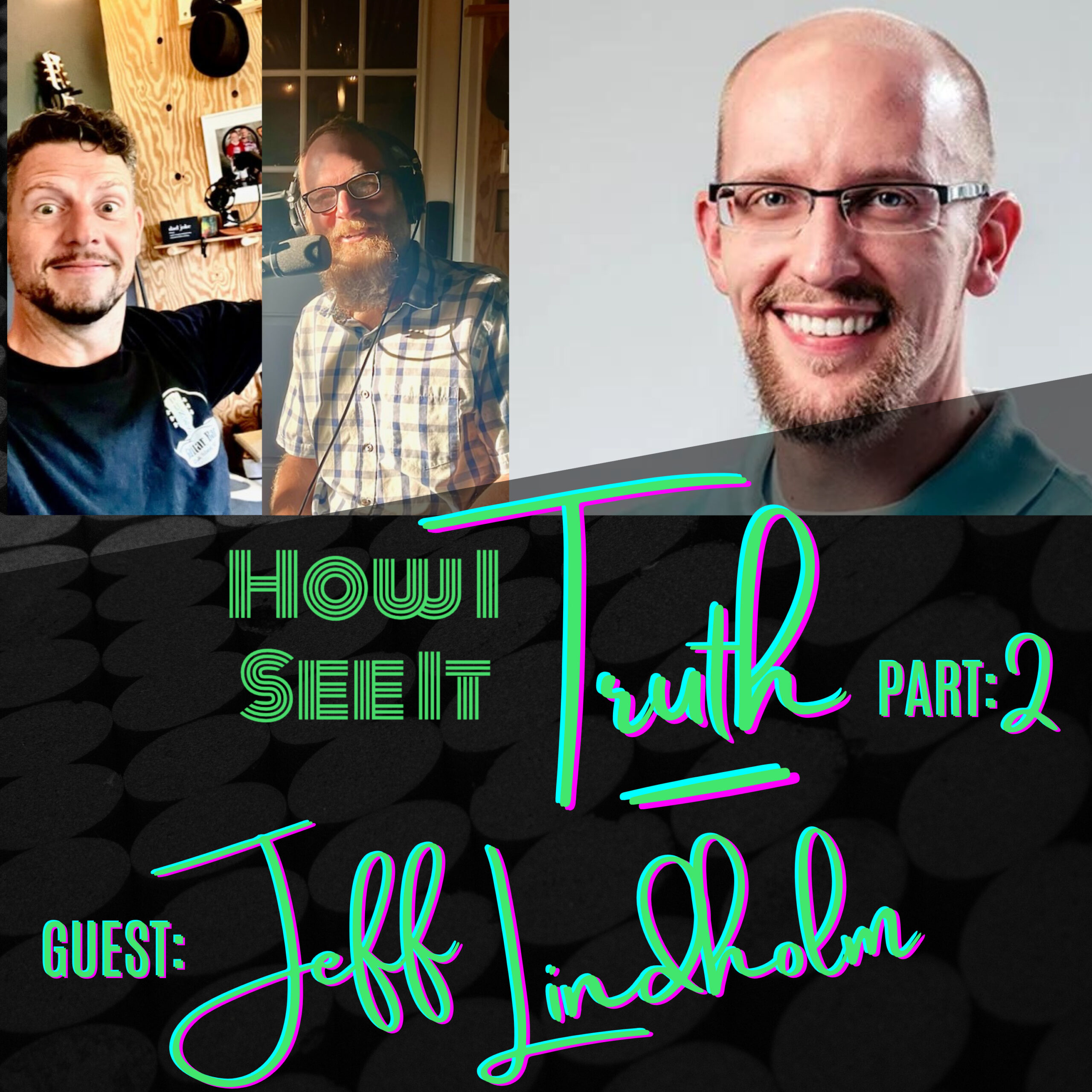
Today, we continue our discussion of truth with guest Jeff Lindholm (be sure to check out part 1!). We continue with our exploration and questions such as: What is truth? How do we determine what is true? And how do we reconcile differing viewpoints on truth? Together, we delve into the importance of seeking truth, both personally and in our communities, and how it can lead to greater understanding and empathy for one another. Join us for this thought-provoking conversation. We know you’ll enjoy listening to our special guest as much as we enjoyed chatting with him.
Show Notes
- Listen to Part 1
- Jeff teaching at Generations Church, “God Is: Truth“
- Jeff on Facebook
- Jeff’s blog, heknowsss.wordpress.com
Show Transcript
Mark:
Welcome to How I See It with me, Mark Pratt and
Justin:
Justin Sternberg. This is a podcast that works to counter cultural polarization. through thoughtful conversations.
Mark:
Yeah, and I think it’s interesting and and like say it’s personal to me more so in some ways, you know, we We think about the civilians. I think you used that word earlier, you know, the civilians that pay in that. But uh ultimately for me, I think that does come back down to families. You know, ’cause so often they what what marriages and what families are, those are the things that are being attacked in that because you know that’s I I think in some ways that is from my perspective that is the the image of God, you know, a designed image of God in that in that process. So we have to dismantle that in some ways, you know to be able to, you know, kind of shall we say, try to erase that image that’s there, you know, that impression, if you will. Mm-hmm. But yeah, I just I so yeah, I think, you know, so often it it really does come back to that dynamic and we you know we go away from you know the aspect of what God has designed, you know, through his church, through, you know, these these th that we are designed to live in this social interaction, this relational interaction, and yet, you know, it it’s about, you know, separating. The government comes to kind of I mean, if you will, kinda almost Satan’s model. Not not saying all government is Satan, but you know what I mean? You know, to to divide and destroy. Yeah. Whereas God came to, you know, bring together and unify and it’s just a It’s just interesting how when we turn it’s it’s very much like you’re saying, when we aren’t basing things on the truth, when we’re left with that lie and suddenly It’s years down the road before we suddenly realize, oh my goodness, this was this was fallacy.
Jeff:
Yeah.
Mark:
So yeah, I appreciate that point in the in that part.
Jeff:
One of the reasons I I feel like Christianity is so compelling and and what the Bible teaches really is true. It stems from what you said, Mark, where The nuclear family, marriage, and husband and wife bearing children, that is the image of God.
Mark:
Sure.
Jeff:
And that is what all healthy civilizations are built on. And throughout history, going back to the the Grecian Empire, the Roman Empire, way back, we have seen empires fall when the nuclear family and marriage becomes corrupted. And one of the reasons why communism was so evil is because Karl Marx hated Christianity in particular. but he also hated the institution of marriage and the nuclear family. Wow. And Marxism, it one of its fa one of its bedrock principles is There will be no marriage, there will be no male and female roles to play in society, and children will be raised by the collective, not by parents. And so throughout communism in in the twentieth century we saw that played out where marriage was marriages were dissolved. and children were raised not by parents but by the state. Wow. And that was one of the reasons why communism never worked and it collapsed. The unfortunate part is that it wasn’t just an experiment that failed and people learned from it. Right. It it resulted in the deaths of millions of people.
Mark:
Sure.
Jeff:
And so That that’s one of the reasons why I get a little upset when I see people advocating for communism here in the United States.
Mark:
Sure.
Jeff:
And trying to bring back these principles where you know, parents don’t have the right to raise their children. We need to delegate that right to the state. The state knows how to raise our kids better than we do. That fires me up.
Mark:
Sure.
Jeff:
Because how can you say that? It’s because you haven’t Studied history. Sure. Those of us who have, we can say, we know how this ends. We’ve seen this story played out. We already know how the ending is. And um so it’s a it’s a volitional denial of what we should have already learned.
Justin:
I th I think too though, history, looking at history, um is one example of our lenses, right, in my view of the truth versus your view of the truth. And I believe many of the cases where you said Um, if we look at history, we’ll see X. It’s very possible to be on the atheist side, the communist side and say, well, if I look at history, I see Y. I see Christians were involved in that problem. I see the church was involved in that problem. I see, you know what I mean? almost unilaterally, if I if you wanted to and if your view was bent that way you could say, no, I st I think the problem is God there. Is you know Christian you know, b people ‘s weak mind to have to depend on something bigger than s themselves prevented them from doing the right thing. The crutch. Yes, exactly. And so I think that um as Much as relative truth is debunkable, it’s not avoidable. Right? Like there will be a relative truth, and again, that’s how I see it, right? Like no matter No matter how much we admit that there is a central truth, it doesn’t avoid the fact that there’s also relative truth And by what I mean by that is the relative truth isn’t the truth, but it’s there. Yeah. Right? And so we have to play by the r those rules. a lot of times, like where if I want to have a conversation with that atheist and I’m I put you on the spot earlier to say speak like an atheist. Good go. You know, and it’s like, well, good luck, right? But If I wanna have that conversation with the atheist, I can’t say your view’s wrong, my view is right. Mm-hmm Right? Because my view isn’t the truth. And so I think a lot of times we get in those crap flinging battles. Yeah. Right? Where it’s like You know, your view’s wrong and my view’s right. No, my view’s, you know, your view’s wrong and my view’s right. And ultimately that will never be a successful battle. We have to appeal to a higher truth. problem is there, again in that conversation where I’m talking to an atheist, if I appeal to that high authority higher authority they don’t agree with, well, at the end we’ll probably have to come to a agree to disagree. And that’s has to be okay, right?
Jeff:
Getting back to um w what I mentioned before, I think this is where following the consequences becomes important. Because you you’re absolutely right. I can’t walk up to an atheist and say, You’re wrong because he’s just gonna throw that right back in m in my face ’cause again how we see it is different.
Mark:
Well I think it’s even important we’re we’re going with the atheist, you know, Christian but I think, you know, we could even translate this to other religions, other dynamics. Oh, sure.
Justin:
Or even Christians by the Isle fighting for this thing that I disagree with. Yeah. I just wanted to broad all the way to eight yes. Yeah, it’s not so
Mark:
yeah. I’m granted this is a polarizing topic, but I think there’s other pol you know there’s other poles in that dynamic that you’re expressing. Sorry Jeff didn’t mean to interrupt.
Jeff:
That’s all right. I I I feel like it’s it’s having those conversations is a lot more effective if you say, okay, let’s assume your view is correct. What follows logically from that? and then you keep going and if you like where you end up, great. But if you logically follow the conclusion all the way to the end and you realize this is a scary place to be, it’s all based on that foundation. Where did we start? maybe that’s where the problem is. And that’s how math w how you prove theorems in math, that’s that’s how it happens. One of the very common ways to prove theorems in mathematics is the proof by contradiction. Where you assume a premise is true or false. Sure. And then you follow all of the previously established rules and if you end up in a contradiction, it goes all the way back and you have to assume your foundation was false.
Mark:
Sure.
Jeff:
And so you you do the logical opposite of it and you’ve proved it true Does that make sense?
Justin:
Yeah. Yeah.
Mark:
Yeah. Basically a hypothesis, null and void. I mean, to that degree, you’re you’re proving that point. And if it doesn’t, if it doesn’t add up, if it doesn’t If what you’re thinking doesn’t make sense, then yeah, it’s it’s not valid.
Jeff:
Yeah.
Mark:
Yeah.
Justin:
No. Yeah, and a
Mark:
And I liked I like the way like you say y you know, it’s important for us to basically pull the thread.
Jeff:
Yeah.
Mark:
In some ways and and then pull the thread and then pull the thread until the point of being able to say, okay, is this what we thought it was? Is do we end up where we thought it would based on what I initially believe. And I think that kind of brings it back to where you were at at the beginning. You know, it’s like being able to recognize if I’m not If my if my foundation is in error, I have to be able to acknowledge that.
Justin:
Yes.
Mark:
Versus just clinging tighter to it in the hopes of propping it up.
Justin:
Yep. And I think pulling the thread can be useful for that or can actually cement someone in their position no matter how wrong at the when you get to the end of the thread it’s like No, but it’s right. And you know, it’s like depending on how hard you pull and how d you know, and and that kind of thing. Um and and ultimately at the end of that conversation They may or may not agree. Again, it doesn’t matter if we come to the end of the conclusion and say, I feel like I proved my point, but you know, it’s up to you to accept that. And so like if you like going back to the the like using atheum atheism and following it to its logical conclusion, well there is no truth there no and they would say, Yep, I agree. Right? Like ’cause Usually uh I wouldn’t say most atheists atheists, but I would say kind of the prominent ones we know of, they’ve done the homework. They followed the thread as far as it’ll go, and they say, I’m comfortable, I accept what this means, right? I’ve pulled the thread all the way down and I know that it means, well, there is no truth. I know that my my existence doesn’t matter. I understand that what I do today. I only do because it makes me feel good and I don’t know why, but it doesn’t matter because I’m gonna end up dust or whatever. They they pulled those threads. And they’re still perfectly content to exist on that foundation. And they feel like it’s a solid one, right? Um, and I think it’s important to understand that’s not just true with atheism, that’s true From every polarizing viewpoint, right? And I think the value in this kind of conversation is providing new views into the ultimate truth. So that over time I can continue to evaluate my foundation, right? And so in that c let’s go back to this conversation with this, you know, hypothetical atheist, that conversation may not end in them going Oh, you’re right. Like I do believe in a higher power, named Jesus Christ. Right. You know, Son of God, whatever. Uh, but that doesn’t mean it’s not a valuable input into their view that they can no longer discount or remove that, you know, there m you may have had a made some inroads in that in that way. And ultimately it’s about the conversation, you know, I think. Um Yeah. I also think too going back to the civilization thing, so many times it’s much easier to visualize the bad as that side over there, right? Like going, oh I can see it. I got my binoculars and I clearly see they’re they’re at fault and that’s why this is happening, right? So let’s go to dismantling a family. We can say, well, it’s the liberal viewpoint. It’s you know, it’s all these things. Um it’s you know, d the Democrats or it’s even in some cases Republicans doing trying to do the right thing but end up doing the right you know, the you can point to all these things. And the problem with that is it’s short sighted and it’s exactly what the actual designer of that would want, right? So You know, we believe not only in a higher power, we also believe in a lesser power, named the devil, who is has some level of authority on this planet. until Jesus says, Okay, your time’s up, right? And his best schemes are to be under the radar and accomplish his his means, h hi his his goal, which is destruction of Faith, destruction of God, and you know, like trying to get everyone off the track of God as much as possible, but in a way he he knows he’s it’s most effective when he’s not visible, right? So if he can get you pointing your finger across the aisle at that other side, right, then so I think I think it’s so important too often in these conversations to understand that there is something that is making you on the other side believe what you believe. that’s not good, right? And probably on my side too, right? And understanding that ultimately we do have to appeal to that higher higher power and understand These relative truths are being influenced by the Prince of the Air, by a a lion who’s prowling, right And it it influences in in our government, it’s influences in our media, it’s influences in um what I consume, right? Like what I let into my my heart and my brain Um, I don’t know. I just think that’s an important understanding to have. Like there is this ultimate truth. There’s Mark’s version of the truth, there’s Jeff’s version of the truth, there’s my version of the truth, and then there’s this cloud between all of us and it is evil, right? Which makes our view of the truth cloudy. Like Paul said, we have a view, we look through a glass darkly, you know, he’s saying like I have a glimpse of the truth, but when I look through it’s like foggy, right? And that’s evil. That’s our human nature, which is inherently evil, and we’re redeemed when we accept Jesus. And he says, you know, despite that you get to get you know, come on up to heaven because I putting my prop uh initiating my uh righteousness onto you, imputing it, right? Because you don’t have it, because you have this darkness in you and all that kind of stuff. I don’t know, I’m kinda going off on a long rabbit trail.
Mark:
Preach it, Justin. Preach it.
Justin:
I just think it’s important to understand not only is there your truth and my truth and the truth, there’s also this cloud That is
Mark:
Confusion.
Justin:
Yeah. Darkness, confusion, doubt, despair. You know, like
Mark:
And I think it’s interesting you bring up that point too, because I think so often, you know, our our views of God a higher power, you know, are reflected, you know, from our hurts as we talk about it so often, you know, hurts habits hang up type thing. You know, it’s like whether I would want if I pull that thread and I acknowledge that there is God, then my my choices, my my decisions, if you will, have consequences. And if I don’t want those to have consequences, if I don’t want to have to acknowledge, then I can do whatever I want to do. Which seems convenient in the moment. But I think so often as we’re talking about, you know, down the road historically speaking you know, me just doing what I want to do and and not factoring in the benefit of other people or, you know, how, you know how truth is available, you know, I think that that has a consequence and it I think it’s part of the clouding. We don’t want to always recognize. acknowledge that okay, me just doing what I feel comfortable doing while it feels good in the moment isn’t necessarily advantageous long term. And I think so often w it is that confusion and it’s that desire to to construct my view based on the hurts that I desire to cover over or don’t want to acknowledge it it kinda hel it it causes me to live in that shame that pulls back from truth, you know, mm your truth God’s truth, you know, we we want to it it tends to wanna we tend to want to live in that isolated shame And you know, I think even as we talk about other people, I have to acknowledge that myself, even who I am, at times I want to pull back. from that truth, if you will, even God’s truth, because it’s it’s illuminating. And you know, and I think when when we’re able to recognize, okay Illumination isn’t a bad thing, but it might be very uncomfortable.
Jeff:
Oh yeah.
Justin:
Like Mark sitting in the s glare of the sun coming through the window You’re very illuminated, but you also look a little uncomfortable.
Mark:
I’m pretty good. Believe it or not, the sun is… It’s getting higher, so we’re good.
Justin:
I just thought, man, that that was just so I wish you know, I’m gonna take a picture and then the sun came out from behind some clouds. When we post this episode, I’ll uh
Mark:
we’ll post it with our picture with Jeff.
Justin:
Exactly. It’s literally glowing. You have a glow.
Mark:
Oh. I know I don’t have a halo, so other than that we’re good.
Justin:
I mean Jeff does, but the sun’s right on his head.
Jeff:
Yeah, it’s gonna start reflecting on the ceiling now.
Mark:
His top quarter inch follicles up there. You can definitely you can they’re definitely all illuminated. Yeah. Yeah.
Justin:
That’s my that’s how I see it. I see a halo.
Mark:
There you go. Oh man. But yeah, I think it’s important when we’re able to recognize that it’s not always that person over there, it’s sometimes who I am.
Justin:
Yeah.
Mark:
I want I personally at times want to reject the truth because it illuminates the shame that I feel. And I think so often it is that truth that gives us the freedom. To be able to say, okay, yes, this is who I am. I’m able to face it. I don’t have to just keep propping up my my viewpoint in such a way that, you know, eventually it’s like I have to deny that there is a spiritual realm even. You know, I think we go so far as to say, well, I’ll just be dirt. And it doesn’t matter. But yet, you know, as we as we think about that, you know, it’s just it just seems so counter to who we are. you know, to recognize well there isn’t really a spiritual realm and I’m not concerned about that. But I think, you know, that’s that’s that’s the extremes we have to go to, those fallacies, if you will. It’s like, really? You know, is that what you boil it back to that it’s just uh my my life ceases to exist? So there again, you know, that brings in the aspect purpose. You know, and I and I and I just really and I think, you know, the more we talk about it, the more we recognize how how important and I appreciate you bringing that God is truth, you know. to the to the topic as far as being able to recognize how truth is such a foundational part of who God is and what he desires to share with us in this complexity of life. So yeah, that’s my
Justin:
the quote of Marx that I like is all truth God’s truth. That’s not mine.
Mark:
That’s not mine. That’s why I ‘m not sure.
Justin:
I heard it from Mark first, and it was specifically in the context of at some point we were talking about having Mark teach at CR. This is what I remember. Kind of the original r when I heard you talk about it. Um so Mark’s also taught at CR, which is pretty cool. Celebrate recovery. And um when I approached you it was like I think a lot of the things that you deal with in counseling or whatever, a lot of that training probably translates pretty well to the steps and lesson you know of of CR and I think that’s when you kinda said, Well all truth is God’s truth. And I was like, yes, exactly. Like there’s stuff that you’re learning in learned in counseling school and to become a therapist that are directly aligned with the the lessons that we’re learning in Celebrate Recovery and And same with you you know, you spoke on truth and you brought in math, right? And so if if math is true, that’s also God’s truth. You know, if it if sure if there’s truth in the schooling that you got for therapy, that’s God’s truth. If there’s truth in Cell recovery, which was based on the twelve steps, which is based on Alcoholics Anonymous twelve step. Like there is so much truth in that. Well guess what? That’s also God’s truth. And I’m curious, Jeff, if you have any thoughts on that in terms of Is there truth that doesn’t map back to God in some way? Or like how would you how would you define that?
Jeff:
I will admit that the first time I heard that phrase, all truth is God’s truth, I immediately said, No, it’s not. Because it it invoked in me images of of postmodernism where someone is saying, Well, it’s my truth that something or other. Sure. And well obviously that truth doesn’t come from God. That truth comes from a rejection of God. But hearing you explain it like that, where if we use math or if we use science to figure out something that is constantly true, that is reproducible, that is predictable according to some Soup not maybe not supernatural, but some unseen plan.
Mark:
Sure.
Jeff:
Then yeah, there’s only one place that could come from within how I see it. and that that source has to be God as as truth. Sure. Yeah.
Mark:
Yeah.
Justin:
Yeah, because truth always comes back to some origin, right? Like a pl like you said, a plan.
Jeff:
Yeah.
Justin:
Authority. And yes, authority. Yeah.
Mark:
A higher authority.
Justin:
Yep. And That’s the thing about atheism andor big bang stuff like it’s like you if you just have to keep going back, okay, but where’d that come from? Okay, but where’d that come from? Okay, but where’d that come from? Okay But where did that come from? Right? And there’s only one way to get to an origin, and that’s if you believe in this origin, right? You have to believe in an origin that supersedes everything. Yeah. No matter what you believe, you have to. Come back to an origin, right? Mm-hmm. There’s no get and there’s no escaping origin.
Jeff:
Right.
Justin:
Right? And so We just happen to have a very convenient origin. It’s very well defined in a in a Bible called the book, and it’s been authenticated. This origin idea has been authenticated. throughout history because it’s true, right? But if you don’t have that, you know, then your foundation’s built on what? Like I don’t I don’t know, you know And I would I would I think they would say, we also don’t know. You don’t know. I don’t know. We can’t know. We’re an ant. Why would an ant know where an ant came from? Right? Well, if the creator of the world came down and said, hey ant, just FYI, you were created by me for this purpose, you know, that’s how you can know.
Jeff:
Yeah.
Justin:
Which is pretty cool that he gave us that opportunity to to to know our origin. You know, unlike any other creature. We know exactly where we came from, what the plan was, what you know. No, we don’t know at all because we’re not the originator, right? Um I don’t know. Origin is uh I think You cannot separate truth from origin, right? Like they kind of go hand in hand because truth is about can going continue to go back up the authority chain till you have a definitive source, origin.
Jeff:
Yeah, I totally agree.
Justin:
Yeah, and it’s kinda like math. Like like you said, you you take your premise and you just work backwards to the origin and if it doesn’t align with your premise you have to fix your premise. And do it again until you get to the origin. You go, okay, we got it. You know.
Jeff:
Math is I I heard it that math is the fundamental science because it ‘s a good idea. It’s follows the the scientific method where you start with a hypothesis and then you perform experiments. And if you don’t reach the conclusion that you expected, you go back and refine your experiment until you either prove your hypothesis true or false. And what’s what’s interesting is uh people still reject well okay follows the scientific method but it’s not a science But all natural sciences do eventually boil down to math. If you take if you take biology, the study of life, what does What does biology boil down to? Boils down to chemistry. How chemicals interact with each other. If you boil chemistry down, what are you left with? You’re left with electromagnetic forces because it’s the forces behind the particles that do the reacting. Well, if you boil physics down, what do you have? You have math. And if you boil math down to its bare bones constituent parts, you end up with logic. If this then that true, false. And um that’s why logic is very powerful when it comes to convincing people of of opposing viewpoints. getting people to follow their arguments to their logical conclusions. Logic transcends culture, it transcends time. All cultures on earth have logical thinking. Even though they speak different languages, they they have different attitudes, it all boils down to I don’t do this if I know it’s false or if I know it’s destructive. No one does that. You can think it’s acceptable and follow it. And then learn later that it is destructive. But no one intentionally does something that they think or that they that they wholeheartedly believe is destructive. At least how I see it.
Justin:
Yeah. Yeah, until your mind is given over to a certain level of darkness. I mean it I I think of suicide as a perfect example. Right, where at that point I know exactly what what I’m doing is destructive.
Jeff:
True. Um I I have dealt with suicidal thoughts, and one of the things that I remember thinking is, yes, I will be destroying me. But it’s better for the people in my life. Mm-hmm. And so as as sick and twisted as that is, and I was in a very dark place when I was thinking those things. uh destroying something that needed to be destroyed was better in the long run. That was that was my thinking. It might be different for for someone else.
Justin:
Great point.
Jeff:
Yeah. But um that’s that was just my perspective when I dealt with that. Hmm.
Justin:
Wow, yeah, that’s I I agree with that. That makes perfect sense. Um Yeah. I think still logic logic only works if you’re willing to consider the if then then if this then that, you know, but if you’re again denial and and Evil will want you to cling to something that’s untrue and therefore deny truth. Right. And and this occurs in Mark and Justin and Jeff as well as, you know, the atheist who’s terrible th you know, like or, you know, whatever the the liberal whatever Th at some point we get to a point where we look at truth and you say, nah. Mm-hmm. I don’t think so. Because my experience says this, you know, and my experience supersedes truth. And that’s just again that inherent you know, for me it’s very clear. It’s our inherent evil nature to follow evil naturally. That’s our natural bent. until we have a savior who imparts his Holy Spirit to say, hey, you know that thing you want to do? Maybe don’t do that. Maybe do it my way, you know? And uh that’s yeah.
Mark:
Well it’s it’s interesting, Jeff. I appreciate I’m still thinking on um that that dynamic as you boiled it down. Cause I from my perspective, I w I would have switched in the last analogy, um, as you were talking about the sciences and you know, it I w I would have flipped physics and math And and here’s where that comes from. And I and I can be wrong, of course, but here’s where because I think from my perspective in our culture, you know, we well, look at the government and how it does finances. Okay. It doesn’t was what I’m saying. That’s
Justin:
truth being
Mark:
but yeah, exactly. But yeah, it’s it it is like I see physics as taking other factors into consideration that math doesn’t. You follow me to where and I think our like I’m thinking of it in terms of um like global warming. We have a formula that says, you know, this is global warming and this happens from my perspective based on math. Because it’s this, this formula. But it doesn’t take into effect the physics of all the other factors that are outside of that equation. Does that make sense? And and granted, I’m I’m willing to recognize that, yeah, math more fundamentally uh may take in all of those dynamics of physics, but that’s not how I’ve seen it until we’ve had this discussion in that process of being able to recognize it in its because ultimately physics is, you know, a a science of math, you know, angles and and impact and vectors and all that stuff. The stuff. But you under it’s like and I think so often I’m learning from you in that process to recognize that, yeah, math can be more fundamental But I think so often our viewpoint of what the because I think as humans our desire is to operate according to a formula. And our our tendency is to say this, this, and this equals that. And yet there’s only so many factors in my formula, and life is more complex than that. So that’s where I saw the difference between physics and math from my personal perspective, but I’m willing to recognize, yeah, I agree with you in that sense that behind the physics underneath the physics is a math and then like you say that that makes the logic more possible as well. So yeah, I appreciate you sharing that because I just wouldn’t have I hadn’t thought about it from that perspective before.
Jeff:
Yeah. I I was mostly referring to like the the operations.
Mark:
Sure.
Jeff:
So there are predictable ways in which physical material, you know, energy and and matter interact with each other and we can represent those predictable interactions with addition, multiplication, division, integrals, all those things. And um so it’s it’s the the operational side of physics that boils down to mathematics. Sure. In that way.
Mark:
Yeah. No, I like to say I appreciate that perspective.
Justin:
Yeah, it’s almost like The problem is the inversion. Well excuse me. So uh when you try and define physics through a mathematical formula, it will it can fall short, but you can properly invert that and s see the physics and then verify it with math, but you can’t create a math formula and then make physics match it, right? Because you can’t invert that and I think maybe that’s The problem that you’re that you’re you you you were reading about or you know about the limitations. Yeah, the limitations, yeah. So you can’t you can’t invert them.
Mark:
Yeah.
Justin:
Right? I think. And I think even to follow that, um, sometimes we invert logic, so we we say if this and that first and then we make Life follow that. Yeah. I don’t know if that makes sense, but we we come to a conclusion that’s incorrect and we kinda invert logic. Is that I don’t know, maybe that doesn’t make sense. As I th as I say it out loud, I’m like maybe that’s not right.
Mark:
I’m still listening. I’m still listening.
Justin:
Stop listening. Everyone hit stop right now.
Mark:
I’m not disagreeing with you yet. I’m still just deciding.
Justin:
I think I lost my spot, but Um that’s okay. Jeff, bail me out.
Jeff:
Put me on the spot. You guys have that relationship.
Justin:
I can’t save that.
Jeff:
I was trying to go along with you and I was trying to trying to see where you were going. Uh did you have an example in your mind that you would
Justin:
No, because ultimately um I think what what my thought is we come up with the conclusion and then we live life to try and prove it. Which I think is an inversion of how logic should work, right? Which is um we have to look at our how life is based on the truth and we you know so I feel I guess that’s kinda I was getting as I think sometimes we invert that which causes problems and creates those denials and creates the bad foundations cause We’ve inverted uh how that should work. Um we’ve come up with how we want it to be, and then we build a life based on that. instead of saying, No, what is it actually and then building based on that. Um and I don’t think I can quite draw the connection to the math and physics and all that, but um I’m sure it’s somewhat related and that it’s truthish.
Jeff:
Some what someone more advanced than than us can can understand what you were talking about.
Mark:
The analogy he had for the circle. The 360 degrees, you know, its part. You did your little no offense, it was a little flex there on the stage when you you brought out the uh
Jeff:
I didn’t even mean it to be a flex. Like when when I wrote that part of the sermon, I was not intending to come across as like
Mark:
Oh well it it sounded like a perfectly good flex from the stage.
Jeff:
That’s not
Mark:
you know it’s like I’m a ma you know this is my formula. I’m a mathematics major so it’s like everybody knew where it was coming from. Or it seemed as if everybody knew where it was coming from.
Jeff:
The the only reason I even called that out is because people started laughing. People started laughing at the nine o’clock service too and I paused for half a second because I’m like, why are people laughing?
Mark:
This is serious.
Jeff:
I meant it totally seriously. I didn’t I didn’t mean it to be a flex at all. And then I realized, oh, maybe it’s slightly more advanced than people were expecting on a Sunday sermon. And of course it was too late to change it and so I’m I I felt at at the eleven to to call out like Remember, I’m a math major and so I as a math major I kinda have to. I’m obligated to give you the geometric definition of a circle instead of a you know layperson Muddled, muddied definition of what a circle is. And and people laughed at the 11 o’clock too. And I’m like, oh I’m sorry.
Mark:
I’ll be honest with you, Jeff. You know what I appreciated most about the circle? It wasn’t so much the formula as much as it you you boiled it down to every circle is three hundred and sixty points. And for me, that that illuminated truth from that sense of that’s how we often come at it is from our own individual 360th of the truth. And yet God is so much bigger that we just can’t necessarily see it all the time. But that doesn’t mean that when I see that 360th, that is part of that whole equation that says yes, that whole three hundred and sixty is God’s. So any part of that three hundred and sixty is still truth.
Justin:
You know what else that’s fascinating?
Mark:
From the look on your face, I recognize that wasn’t the intention. But it It you if I may, you were you were bringing it back to the point of we know something based on this formula that says this is what it is.
Jeff:
Yes. It’s the definition.
Mark:
Yes. And that’s where
Jeff:
if if we follow the definition to construct a circle.
Mark:
Yes.
Jeff:
That is what we have. It cannot be anything else. Um part of the look on my face that had you so captivated just now is that I never mentioned 360 degrees.
Mark:
Really?
Jeff:
I really didn’t.
Mark:
Now uh now see there again. We’re gonna have to go back to the recorded version. No, not this guy. But I when you started the circle Would okay, and I’m not defending myself here, but I d I I might not have heard 360, but did like point How did you define the beginning of a circle?
Jeff:
The definition of a circle is for an arbitrary point O and distance R.
Mark:
Gotcha.
Jeff:
A circle is the set of all points within one plane.
Mark:
Sure.
Jeff:
such that the distance between O and any point in that set equals R.
Mark:
Gotcha.
Jeff:
Yeah, Justin’s flexing his bicep right now. And and they’re laughing just like the people in in church, they’re laughing at that.
Justin:
You uh you uh mistranslate the laughing. The laughing is like Holy crap. That’s smart. I love it. Yeah, and
Mark:
that’s what it is. And I appreciate you share your cause like you say the minute I heard point That’s where I went.
Jeff:
You went to a degree that I’m going to do.
Mark:
I went to that 360th of that circuit.
Justin:
Take your well your point and and magnify it too, because like Which is not again, it doesn’t follow what he was trying to m the point he was trying to make with the circle thing. But the three hundred and sixty degrees, you know, the thing about a circle, correct me if I’m wrong, there’s infinite points on the outside of a circle. There’s not a defined set of points.
Mark:
I agree.
Justin:
They’re infinite. I mean it might it’s just mind-blowing to me. So Which when you think of God, he’s not a flat plane, he’s not a circle. It’s it’s more accurate to make it an orb. And now The infinite times infinite, right? Infinite times three point one four or whatever. I don’t know. Whatever the math is, Jeff is just he’s just very upset with that. And then you have your pie and you eat it too, so Uh
Jeff:
so if you want to get really mathematical, I do
Justin:
flex.
Mark:
Justin does.
Jeff:
So a
Justin:
both biceps.
Jeff:
How how how many points are in the circumference of a circle contained in one plane?
Justin:
Well is that pi?
Mark:
Yeah. Yeah. Yeah.
Jeff:
You had it right. In there are infinitely many.
Justin:
Yeah.
Jeff:
How many points are on the surface of a sphere?
Justin:
It’s infinite times infinite, right? Like
Jeff:
It’s the exact same number.
Mark:
Oh.
Justin:
How dare you? Well, infinite is the same numbers Infinite times infinite, right?
Jeff:
Well see that that’s that’s the property of infinity. Infinity multiplied by any number is
Mark:
it’s that little sideways eight no matter what infinite.
Justin:
Yeah.
Jeff:
Yeah. It’s so there there are exactly as many points.
Justin:
Sideways eight.
Jeff:
On a circle as there are in a sphere. You don’t have to multiply it by anything. Yeah. But anyway, I didn’t mean to derail the conversation.
Justin:
I’m easier to visualize like, okay, it’s not only infinite this way, I’m drawing a circle. But then you rotate it and now it’s infinite again and rotate again and it’s it’s infinite this in this plane as it is this plane. You know. But again it’s the same number except it visually it’s like no it’s just like even more infinite.
Jeff:
Yeah. You know
Mark:
So if it’s infinite, how does it get divided into three hundred and sixty? ‘Cause that’s the degree that’s the amount of clicks from the center. I’m curious, because I think about things in degrees. I’m a construction person, so of course I think about things. So yeah.
Jeff:
That I think that goes back to what, the Sumerians They were the first game. They were the first per people to divide a circle into or or to divide time by a number of sixty intervals.
Mark:
I gotcha. I because that was until this morning that was the first time I’d really thought about yeah, there’s a bunch of points.
Justin:
Yeah.
Mark:
But yeah, I still think about it as like a clock and having three hundred and sixty minutes in it. If you will. Around the clock.
Justin:
Which you could divide a circle as many points as you want. Clock is an example. No I agree. Uh we use degrees as three sixty, but you could go eight hundred and ninety-two if you wanted, right? It has to be even though
Mark:
we’re going to be able to do that. Well you could divide seconds into m milliseconds and I mean, yeah. But I just Yeah. I mean So point became a degree for me in the midst of your sermon. So that was that was where I was that was how I was seeing it. So thanks for that.
Jeff:
That’s an interesting perspective. That that’s where your mind went and that’s what you remembered. Even though I never said it. Yeah. That’s that’s interesting. Yeah. It goes back to what you said about how there’s…
Justin:
We still don’t know if you didn’t say it. So until we have the truth.
Mark:
The evidence is there. No, I’m I’m good. I’m good with what you said because I’m willing to recognize Recognize how I would translate a point. When you said the word point, I automatically thought, okay, one of three hundred and sixty ‘Cause how often do we hear that? You know, but I’m yeah, I’m also willing to recognize that’s cool that in between each three hundred and sixtieth there’s far more parts. But yeah, exactly
Justin:
a minute more, right. There is no number. Yeah. That’s where The eight turns out. Come on, Jeff. Stay stick with us here.
Mark:
So yes. Well thanks for sharing that part. Now see this is this is the uh this is the what do you what do you call it? The B plan? No.
Justin:
B roll. B roll. Yeah, this is the this
Mark:
is the B roll. This is the outside.
Justin:
This is the good
Mark:
the outtakes of what really happened. That’s right. You know, the stuff is a little bit more than a little bit. The good stuff Jeff left at home on… the stuff he thought he didn’t say, but he actually did, but he didn’t, but that’s what you heard, therefore he said it. So, that’s, you know, why. Coming back to that, were there were there any other parts that you uh cut?
Justin:
Yeah.
Mark:
Just for the sake of time?
Jeff:
Uh yes, there when I when I’ve been writing sermons it’s it Pretty much a a general rule that if I if I preach for thirty-three minutes, uh huh, I originally wrote enough material to preach for fifty to sixty.
Mark:
Okay.
Jeff:
So I I’m cutting approximately half of my material in order to make time. And that’s something I never expected. I I honestly expected to struggle before I started writing sermons, I expected to struggle to fill the time. But it’s actually a struggle to keep myself In time. Oh, sure. Which makes total sense now that I’ve seen so many pastors go over their allotted 35 minutes or whatever. I’m like, it’s easy to do. It’s very easy to do. Um Yeah, I I talked about um how how important it is to to base your life on truth and why why my s my sermons have been so heavy with scripture. Um Because I am not an authority. My truth is no truth at all. Um I forget where it says it in the Bible where it says um they’ve been following a gospel which is no gospel at all. In in the exact same way my truth is not is no truth at all. And so th there there was a part I was hoping to be able to include but I there there just wasn’t time to do it Where I I talked about that is the reason why my sermons are so heavy with scripture, because that’s my purpose. The reason I’m up on stage is to speak truth into your lives and if I’m not doing that then I’ve lost my purpose. And if I quote one scripture I know I’ve said at least one thing that’s true.
Mark:
Sure.
Jeff:
So the more scripture I can quote, the more assurance I have that I’m speaking truth.
Mark:
Sure. Yeah, that’s that’s a great point.
Justin:
I uh Yeah, that’s that’s amazing. Um I think often, you know you’ve probably heard this. If you put this much scripture in it, people will fall asleep.
Jeff:
Yes, I I I have heard that. Where if if all you do is stand up there and read and read and read scripture, you will put people to sleep.
Justin:
For the record, when you go listen to his message, you’re not going to encounter that. Jeff does a great job presenting those scriptures as if He’s just saying it himself is is amazing. But there is truth to that, right? Where if you just stand up and read scripture, truth it’s still truth, but it’s not gonna hit the same if if we just kind of go In the beginning. Um but uh I guess I was gonna say uh oftentimes when I speak I don’t I I I I’m challenged by what you said. Definitely challenged by it. Um ’cause what I bring to the table is what I have is me. You know, and so I’m gonna present me and trust that the Holy Spirit works himself through it. Now, that doesn’t mean I avoid scripture. I try not you know, I that’s not that that’s not the point of what I’m trying to say, but like When you think of testimonies, um very clearly the the Bible says that is one of the most powerful things we have on this planet is our testimony, is my truth When it interacts with big G, capital T truth, but God truth, right? Like when when those things intertwine and that story builds itself my version of the truth versus his and how they start to align that has a power that stands on its own validated by scripture, right? Like the Bible says, By the word of our testimony. What’s the other part of it?
Jeff:
We triumph over the the devil by the Blood of the Lamb. And the word of our testimony.
Justin:
Yeah. Thank you. Thank you, yes. Um, and obviously it doesn’t say and also God’s word, but that’s a no-brainer. Um, and it says it many other places in the Bible But there is something to almost kind of the opposite of what you said. I don’t have truth, no, but I have my story, which interacts with the truth and God uses that in us to when we share a story. And that’s why we include personal elements, you know. Um I don’t know what are your thoughts on that, Jim?
Jeff:
Uh uh uh a way of looking at that is not necessarily my My story becomes the truth, but when I apply the truth of God’s word to my life, my life changes.
Justin:
Yeah. Yeah.
Jeff:
And that might have been what you were saying without those words. That’s that’s just how how I see it. That It’s it’s not necessarily I make God’s word true by living a certain way. It’s that God’s word proves itself true when I conform my life to it.
Mark:
So I saw you as an infinite part of the circle, Justin.
Justin:
Oh thank you. I appreciate that. Sideways eight.
Mark:
Yes, you were a part of the circle in that moment. That’s right. This is God’s truth in my life in this.
Justin:
Yes, this is my viewpoint on the infinite plane of of the truth and I think that’s the m
Mark:
the word my I think was the the difference. Yeah.
Justin:
I like that you tied that back in, joke joking or not, because every person I mean we’re involved in celebrate recovery and every other week we get a testimony And it’s one of an infinite number of viewpoints into that orb of truth, which is God, right? It’s a a viewpoint. But every time you get another point, that’s another point that you ha of a view that you have into the truth, right? So you’re true. That’s why I love testimony so much. It’s like they build your faith so much because you’re hearing, oh God worked that way. Whoa. Oh and this way? Oh what? Oh and then the opposite way. Like okay. And you’re like building this orb of truth of who God is through the lens, these infinite points on a orb or sphere, ’cause it’s the same number, to build out a broader and broader view. And knowing that because it’s infinite, you’ll never have all of the view. Mm-hmm. Because it’s a sideways eight. But you the more the more points you can get, the broader view you have of the truth. And that’s what I love about testimonies as oppos you know, not as a post, but in addition to scripture, which is specific I don’t know Even even scriptures are a viewpoint, right? Like there are also points on this infinite sphere. Because the Bible has how many names of God, right? hundreds, I don’t know, we talk about that, we sing about it, all the names of God. And if we just take one of those and say this is who he is, you know, it’s not enough That’s why there’s so many. So they’re all viewpoints, and all these scriptures give us another viewpoint. And so even all of Scripture cannot give us Unless we spend eternity, you know, sideways eight, spending our time reading these scriptures and hearing the Holy Spirit teach us about it Right? Like I’m using my
Mark:
Justin, you’re a regular mobile this morning. You know, that thing’s spinning. You got hands flying all the way around in your sphere and you’re pointing at you’re a mobile.
Jeff:
I’m surprised you haven’t knocked your microphone out.
Mark:
I give you credit with all of your gestures.
Justin:
Uh I got a lot of experience with this bad boy.
Mark:
Exactly. And it started with Rowan and it’s just it’s just ramped up from there.
Justin:
The the rest of the people you’re not getting my my hands. Should have been videoed. We’ll have Jeff back and video it. But you get the point.
Mark:
We do, and I think uh what I like about what you were sharing is, you know, as we gain all of these different you know, as you listen to someone share their testimony from that varied viewpoint, I think there’s enough similarity to that other person that I can say, oh That’s very similar to what God’s doing in my life. And I can see that person maybe a little further down the trail. you know, than I’ve been and that gives me hope.
Justin:
Yep.
Mark:
And you know, and then to be able to recognize, okay, yeah, that’s God’s you know, process of developing hope is to be able to say, okay, yeah, as I’ve done it in his life, basing when a or his or her life, as they base their life on my truth They go on this journey and that journey is possible for you. And even as you share, Jeff, you know, that aspect of coming to know that a fuller aspect of the truth was basically what helped you overcome the lie of my life isn’t important or, you know, it’s an encumbrance to other people. And you know, it’s just it’s just neat to see how that truth transformed, you know, your journey in the from that dark place.
Justin:
Yeah, as I know I don’t want to keep Jeff’s super duper much longer, but I’d love to wrap up with a final question if that’s if that’s cool with both of you. Um, which is can you draw the line, draw a connect cause I was gonna start talking about it, but I this we struggle with this, right, Mark? When we get a guest in here we’re like used to doing all the talking, we’re like, shut up Shut up, Justin. Shut up, Justin.
Mark:
Not what it’s like.
Justin:
No, but I really I think I would love to hear your perspective on this, uh Jeff the connection between truth and hope. Because it can go the other direction. Like hope is diminished when we you know, I would love to hear your your connecting those dots because when I hear you speak about truth, I hear hope. Does that make sense?
Jeff:
This was a a point I covered in my sermon where If God is truth and everything he says is truth, then what should we think when he makes a promise? We can count on it.
Mark:
Sure.
Jeff:
And there Worry and doubt, though God understands it, because he was tempted in every way we were It is simultaneously a bit of an affront because he’s saying, I am truth and I promised this would happen. And so for you to doubt means you don’t believe that I am truth. You you’re you’re not accepting my word as you should. And and so if we if we have the correct perspective that nothing God says is false When he promises to do something, it will happen. We have no reason to doubt, we have no reason to fear, we have no reason to worry, it will happen. We can count on it. And God’s word promises multiple times that when we turn our faith over to him, when we turn our lives over to him. Um in Deuteronomy, Moses said, I lay before you life or death. And I want you to choose life. God wants you to choose life. And if you choose life, you can count on these promises to be fulfilled.
Mark:
And that for you becomes the source of hope.
Jeff:
For me, that’s hope. And it’s it’s not hope in the sense of like, oh I hope it doesn’t rain. Um we we’ve we’ve lost Yeah, we we I think we’ve lost a little bit of what the biblical idea, the biblical concept of hope actually means, because we’ve watered it down in modern English where hope is optimism. I hope you have a good day. Well I can’t control it. I’m just optimistic or or or whatever. But in the biblical sense, when when the writer of Hebrews says we have hope in our our coming salvation, he’s not saying we’re optimistic. He’s saying we have confidence based on facts, based on evidence, based on God’s irr irrefutable promise, an unbreakable promise, that it will happen. And that’s how we’re able to live our lives, fearless with the authority that God says, I I’m releasing you into the world to go with my authority and be bold for the gospel. Because we have this hope.
Mark:
Sure. Confidence.
Jeff:
Yes, we have we have that confidence and assurance that God’s word will be fulfilled.
Mark:
Yeah. Well said.
Justin:
Yes.
Mark:
Nice job.
Justin:
Thank you, Jeff.
Jeff:
You’re welcome.
Justin:
And thank you. Thank you not just for that answer, but thank you for Taking the participation. Participation. Yeah. Come on over here and let us make you a little nervous and pick at you a little bit.
Jeff:
Yeah. I don’t it you guys didn’t make me nervous. I think it was mostly a self-inflicted thing.
Justin:
Well I tried. I tried to make you nervous. Oh, yeah. I tried to assure you that…
Jeff:
How many people are going to be subject to execution because that judge was not Convinced by the things I said
Justin:
we’ll get back to you on that.
Mark:
Oh gosh So yeah. Thanks thanks for sharing. Yeah. Really. Appreciate you uh you joining us.
Justin:
Yeah. Thanks for sharing how you use
Mark:
the invite. Yeah.
Justin:
Yes.
Mark:
That’s how we see it.
Justin:
Hey, thank you for listening to our podcast. If you like how I see it, please do all the things that podcasts tell you to do. Subscribe, rate, review, follow us, uh, and or talk nicely about us on social media. If you want to reach out, the email is us at howiseeit.click. Yep, I said dot click. As in dot click Please tell your friends about this show, and we’ll see you on the next one.